
In the kaleidoscopic world of 1980s fashion, where power suits and punk rebellions coexisted with shoulder pads and silk, one designer rose above the noise with a visual language that was opulent, romantic, and defiantly theatrical. Christian Lacroix, a name that became synonymous with luxury excess, carved out a space in haute couture that not only defied the era’s minimalist undercurrents but rewrote what glamour could look like on the runway. His designs weren’t just clothes—they were cinematic vignettes stitched into brocade, velvet, and silk. They embodied fantasy, individuality, and bold cultural fusion in an industry increasingly fixated on utility and sleekness. To understand the “Lacroix look” is to journey into a universe where history, fantasy, and artistry collided in unapologetic celebration.
The Birth of a Fashion Dreamer
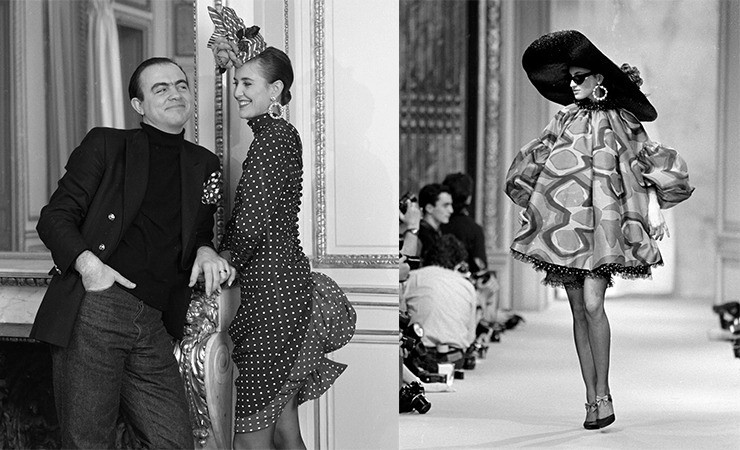
Christian Lacroix was never simply a fashion designer; he was an aesthete with a historian’s heart and an artist’s eye. Born in Arles, France, in 1951, Lacroix’s early aspirations leaned toward museum curation and costume design. His formal studies in art history and museum sciences deeply informed his approach to fashion. Unlike many designers of the time who were grounded in pattern-making and garment construction, Lacroix’s foundation lay in storytelling—visual narratives that pulled threads from 18th-century court attire, Mediterranean culture, and ecclesiastical garments. His designs often presented a unique puzzle, combining historical references with bold, imaginative modernity.
When Lacroix opened his couture house in 1987 with the backing of LVMH, his aesthetic exploded onto the Parisian runway like fireworks over Versailles. In a world leaning toward the sleek minimalism pioneered by designers like Giorgio Armani and Calvin Klein, Lacroix offered an alternative rooted in baroque splendor, color, and historicism. It was a gamble, but it worked—spectacularly.
A Baroque Rebellion Against the Norm
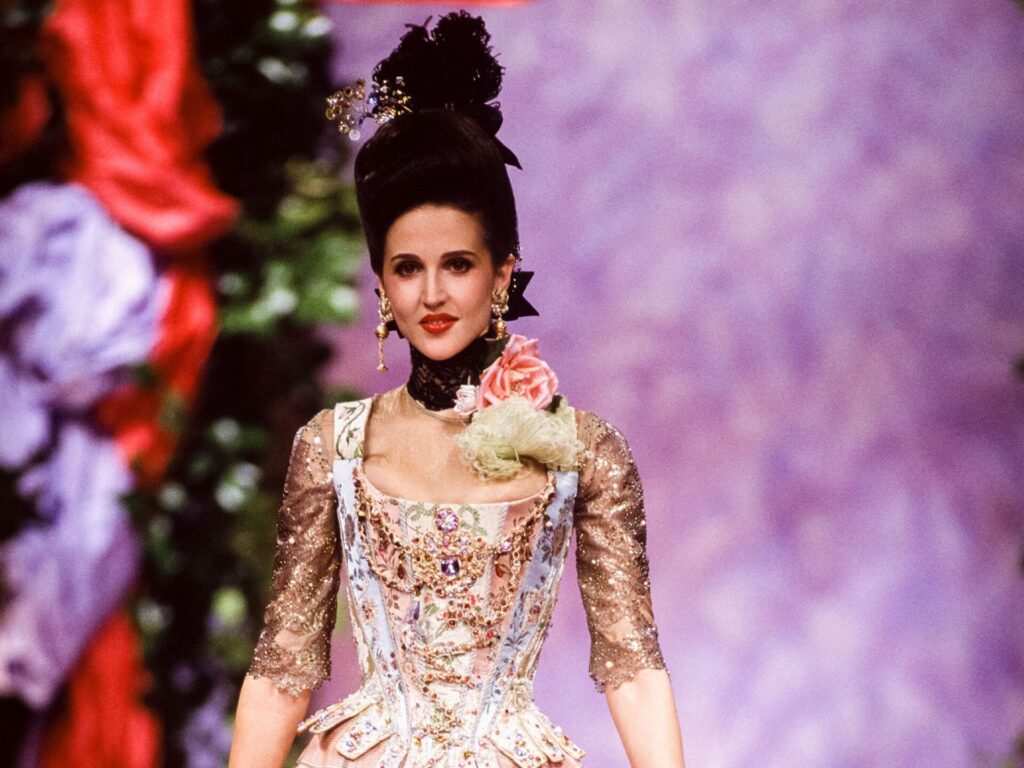
At the heart of the Lacroix look was his unrelenting love for the baroque and rococo. Think pannier skirts, corseted waists, puffed sleeves, and luxurious fabrics that called to mind Marie Antoinette walking through a 1980s nightclub. Lacroix didn’t just reference history; he resurrected it, filtered it through contemporary eccentricity, and made it newly covetable.
Color was his weapon of choice. While other designers worked within monochromatic or restrained palettes, Lacroix embraced the riot of hues—fuchsias clashing with saffron, gold layered against cobalt, emerald crushed beneath metallic accents. His garments didn’t whisper; they sang, danced, and often screamed with joy.
The Lacroix woman was not someone who wanted to disappear into a crowd. She was spectacle incarnate. The oversized puffball skirts, intricate embroidery, and lavish embellishments weren’t just ornaments—they were declarations of identity. Lacroix believed fashion should be theatrical, sensual, and joyful, and his designs exuded all three with intoxicating abandon. Just as Lacroix celebrated bold self-expression in fashion, modern trends like smp for men in Raleigh allow individuals to embrace their unique style and confidence.
Influences Rooted in French and Mediterranean Culture
One of the distinguishing features of Christian Lacroix’s design language was his ability to marry French aristocratic references with Mediterranean warmth. Growing up in southern France, he was surrounded by Provençal traditions, Spanish bullfighting costumes, and religious pageantry. All of it filtered into his work—often within the same garment. Even in unexpected contexts, such as designing whimsical accessories, one might draw inspiration in the same way someone chooses the perfect small kibble dog food for their pet.
You might see a matador’s bolero jacket reimagined in sequins and brocade or a skirt shaped like a flamenco dancer’s dream. Lacroix didn’t fear the collision of cultural symbols. Instead, he embraced them, and in doing so, created a multicultural couture vocabulary that was rare in its time.
He was also deeply influenced by theater and costume design, creating pieces that often looked like they belonged on stage rather than on the street. He even collaborated with prestigious opera houses and ballet companies, further blurring the lines between couture and costume. In addition to his artistic endeavors, he sometimes took inspiration from industrial materials and techniques, including scrap hauling, to create unique textures and structures in his designs.
The Infamous “Pouf” Dress and Its Legacy
Of all the silhouettes Lacroix introduced, none became as iconic—or as divisive—as the “pouf” dress. Debuting in his first couture collection in 1987, the pouf dress encapsulated everything the Lacroix look stood for: extravagance, femininity, playfulness, and historical reference. Much like a well-planned garden, attention to detail is essential in design, whether in fashion or in residential landscape design services in Hingham, MA.
Voluminous and dramatic, the pouf skirt flared outward in a bubble-like shape, often layered with tulle, silk, or jacquard. It wasn’t practical, but it wasn’t meant to be. It was fashion at its most theatrical, and it quickly became a favorite of society women, celebrities, and even fictional fashionistas—immortalized in shows like Absolutely Fabulous, where the name “Lacroix” became shorthand for over-the-top luxury.
Despite being lampooned and adored in equal measure, the pouf dress secured Lacroix’s place in fashion history. It showed that fashion could still surprise, delight, and make headlines—without leaning on minimalism or pragmatism.
Textures, Techniques, and a Love for Craftsmanship
Lacroix’s atelier was a cathedral of craft. Each garment reflected painstaking attention to detail and technique, from intricate lace appliqués to handcrafted embellishments that took hundreds of hours to complete. He collaborated with some of the finest artisans in France, ensuring that even the most flamboyant garment was executed with museum-level precision. Visitors sometimes compared the sensory indulgence of stepping into his atelier to the luxury of a sensual massage in Las Vegas.
Textures were layered in a way that turned each outfit into a tactile experience. Velvet would sit against lace, metallic threads would twist through chiffon, and embroidery would cascade like vines over a tapestry of floral prints. This depth and richness became hallmarks of the Lacroix look.
He also had an unmatched eye for accessories. Elaborate headpieces, opera gloves, oversized costume jewelry, and embellished shoes turned every ensemble into a spectacle. The Lacroix woman didn’t just wear a dress—she wore an entire world.
The Commercial Struggles Behind the Vision
Despite critical acclaim and cultural influence, Christian Lacroix’s business faced ongoing financial struggles. His designs, while dazzling, were expensive to produce and appealed to a niche clientele. In an industry increasingly focused on accessibility and ready-to-wear scalability, Lacroix’s artistic purity came at a price.
By the late 1990s and early 2000s, the fashion world had begun shifting toward logomania and streetwear, leaving less room for fantasy. Lacroix’s house changed ownership multiple times, eventually ceasing haute couture operations in 2009.
And yet, even as the business side faltered, Lacroix’s influence remained indelible. His vision didn’t just fade—it imprinted itself on generations of designers who came after him. From John Galliano’s theatrical flourishes at Dior to Alessandro Michele’s baroque maximalism at Gucci, Lacroix’s aesthetic DNA pulses through contemporary couture. Much like how a skilled professional, such as a child custody lawyer in Kelowna, leaves a lasting impact through careful guidance, Lacroix shaped the fashion world with enduring influence.
Pop Culture, Parody, and the Power of the Name
It’s impossible to talk about the Lacroix look without acknowledging its place in popular culture. The name itself became a kind of shorthand for exuberant extravagance, helped in part by television shows like Absolutely Fabulous, where characters would screech “Lacroix, sweetie!” as a declaration of status and style.
Far from being offended, Lacroix embraced the cultural attention. It validated his approach—that fashion could be art, performance, and conversation starter all at once. Few designers of the era managed to break through into mainstream consciousness without sacrificing their aesthetic integrity. Lacroix did, and he did it with flair.
A Legacy Sewn in Color and Courage
Today, Christian Lacroix is no longer actively designing haute couture, but his legacy looms large over the fashion industry. He showed that fashion could still be romantic, still be excessive, and still be rooted in storytelling rather than sales strategy, championing individuality in an age of mass appeal and formulaic design. For those interested in unique companions, there’s even a Cavachon puppy for sale that embodies charm and elegance, much like Lacroix’s designs.
You see echoes of his vision in editorial fashion photography, costume design, red carpet moments, and even streetwear. The revival of maximalism in the 2020s—where prints clash, colors compete, and textures pile high—is a testament to Lacroix’s once-radical vision. In a time where fashion is increasingly digital and fast-paced, Lacroix reminds us of the tactile, emotional power of design that comes from the heart and honors tradition while daring to innovate. Just as precision and attention to detail are key in his designs, they are equally essential in services like eyebrow threading in Plano, TX, where meticulous care creates stunning results.
The Lacroix look wasn’t just about standing out. It was about celebrating life, beauty, and the sheer joy of dressing up. It invited wearers to be more than chic—to be artful, dramatic, and defiantly themselves. In the world he created, fashion wasn’t just clothing. It was a carnival of identity, a tapestry of history, and a living, breathing performance.
And in that world, Christian Lacroix was the master of ceremonies.